Pressure Cookers · 5 min read
How to Choose a Triply Pressure Cooker: Size, Shape and Care
What triply means, whether it works on induction, which pressure cooker size suits your family, tall vs broad vs pan shapes, and gasket and valve care.
By Ramachandhraa Stores, Sullurupeta · Updated
Quick answer
A triply pressure cooker has an aluminium core between two layers of stainless steel, so it heats evenly and usually works on induction; check the label to be sure. As rough guidance, choose 1–2.5 L for one or two people, 3–3.5 L for three or four, and 5 L or more for larger families.
The pressure cooker is the hardest-working vessel in many Indian kitchens, used for dal, rice, sambar and biryani, sometimes several times a day. Triply cookers have become a popular choice because they combine a stainless steel cooking surface with an aluminium core that spreads heat evenly, and many of them work on both gas and induction.
This guide explains what triply means, how to check induction compatibility, which size suits your household, how tall, broad and pan shapes differ, and how to look after the gasket and safety valve.
What triply means
Triply means three layers of metal bonded together: stainless steel inside, aluminium in the middle and stainless steel outside.
- Inner steel is the cooking surface. It does not react with tamarind, tomato or other sour ingredients, and food never touches the aluminium.
- Aluminium core spreads heat quickly and evenly across the base, which reduces hot spots and scorching.
- Outer steel gives a durable finish and, when it is a magnetic grade, lets the cooker work on induction.
Some cookers have the three layers all the way up the sides, often described as full-body or fully clad. Others have them only in the base. Labels vary, so check the product description or ask us which construction a model uses.
Will it work on induction?
Generally, yes. Triply cookers usually have a magnetic stainless steel outer layer, which is what an induction stove needs. Before you buy:
- Look for the induction symbol (a coil-shaped icon) or the words "induction compatible" on the box or base.
- Hold a fridge magnet to the base. If it clings firmly, the cooker will usually work on induction.
- Check your induction stove's manual for the smallest base size it detects. Very small cookers can fall below it.
Which size for your family?
The litre figure is the cooker's total capacity. Most manuals say not to fill a cooker more than two-thirds, and only about half for rice, dal and other foods that froth or expand, so the usable space is smaller than the label suggests. Treat this table as rough guidance, and go a size up if you often cook for guests or make one-pot meals.
| Household | Rough size | Options in our range |
|---|---|---|
| 1–2 people | 1–2.5 L | Stahl 1 L, 1.5 L, 2.5 L |
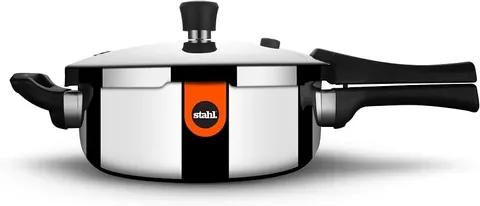
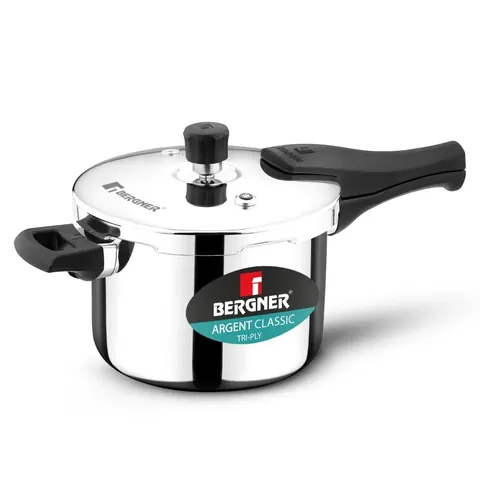
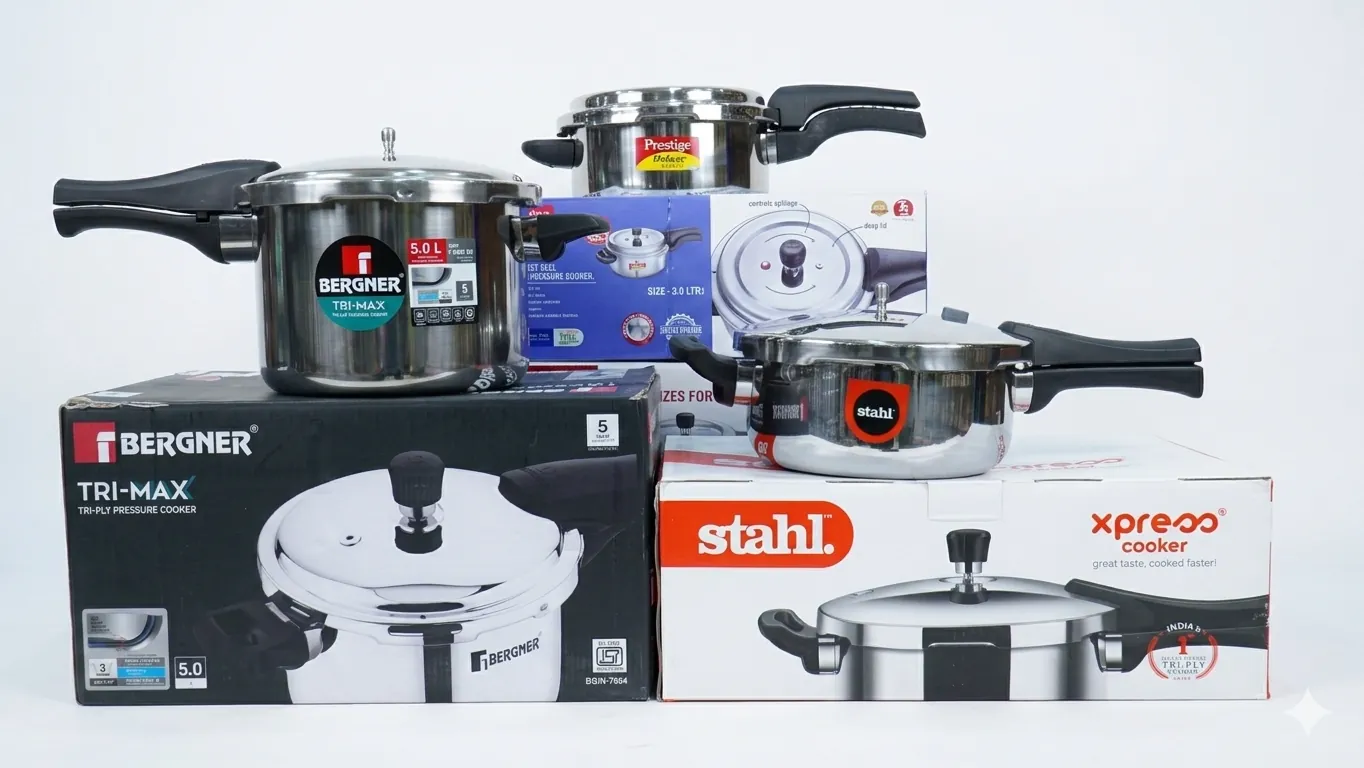
| 3–4 people | 3–3.5 L | Stahl 3 L Broad and 3.5 L Pan, Aceware 3 L Tall, Bergner Argent Classic 3.5 L |
| 4–6 people | 5–5.5 L | Stahl 5 L Broad, Aceware 5 L Tall, Bergner Argent Classic 5.5 L |
| 6 or more | 6–10 L | Stahl 6 L, 8 L, 10 L |
Many homes keep two cookers: a small one for dal and a larger one for rice or one-pot meals.
Tall, broad or pan: choosing a shape
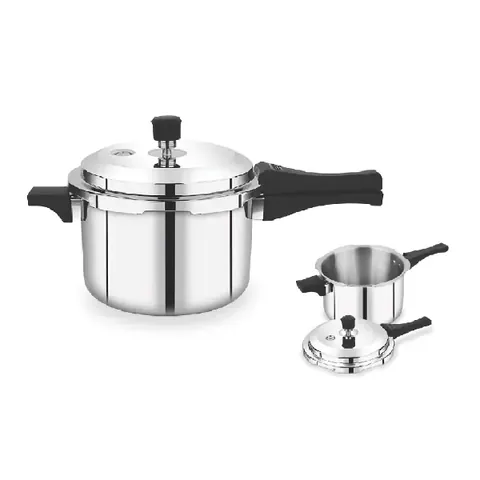
- Tall cookers, such as the Aceware triply pressure cooker in 3 L Tall and 5 L Tall, have a narrower base and a taller body. They take less room on the burner and suit rice, dal and other dishes where you mostly add ingredients and water. A tall body can also take stacked separators for cooking rice and dal together, if your model allows.
- Broad cookers, such as the Stahl triply pressure cooker in 3 L Broad and 5 L Broad, have a wider base and a lower body. More of the food sits on the hot base, so it is easier to fry onions and roast masala before pressure cooking pulao, biryani or curries, and easier to see into and stir.
- Pan shapes, such as the Stahl 3.5 L Pan, are shallow and wide, like a kadai with a pressure lid. They suit dishes you fry first and food you want to serve straight from the vessel. Many pressure pans can also be used without the lid as an ordinary pan; check your manual.
The Bergner Argent Classic triply pressure cooker comes in 3.5 L and 5.5 L.
Gasket and safety valve care
A pressure cooker works safely only when the gasket seals properly and steam has a clear way out. Follow the manufacturer's manual for your model; these are the common checks.
The gasket
- Remove and wash the gasket after cooking, especially after dal or milky dishes, then dry it and fit it back.
- Replace it if it is cracked, hard, sticky or stretched, or if steam leaks around the lid.
- Use only the gasket made for your cooker's brand and size, and keep a spare at home.
Vent, whistle and safety valve
- Before each use, check that the vent tube under the whistle is clear by looking through it against the light.
- Wash the whistle (weight) and make sure no food is stuck inside it.
- The safety valve is a backup that releases pressure if the vent is blocked. If it ever releases, stop cooking, let the cooker cool and follow the manual; many safety valves must be replaced with the brand's genuine part before the cooker is used again. Never block or modify it, and never put extra weight on the whistle.
Everyday habits
- Always add at least the minimum water your manual specifies.
- Lower the flame once the cooker reaches pressure. Triply heats efficiently, so a high flame is rarely needed.
- Let the pressure drop fully before opening, as your manual describes, and never force the lid.
- Clean with warm soapy water and a non-scratch scrubber. A little vinegar or lemon removes white hard-water spots and the rainbow tint that heat leaves on steel.
- Store the lid upside down on the body rather than locked, so air circulates and the gasket isn't squeezed.
Order online or see them in store
The Stahl, Bergner and Aceware triply pressure cookers can be ordered online from our website, and you can also see them at Ramachandhraa Stores on Gandla Street, opposite SBI Bank, Sullurupeta. To check a size or shape before you decide, WhatsApp +91 90807 22578 or browse all our pressure cookers. For triply kadais and fry pans, see our triply cookware.